01/05/2018
WhatsApp founder is parting ways with Facebook
06/04/2018
Facebook Admits Mark Zuckerberg and Top Execs Have Deleted Their Sent Messages Remotely
Filed to:FACEBOOK

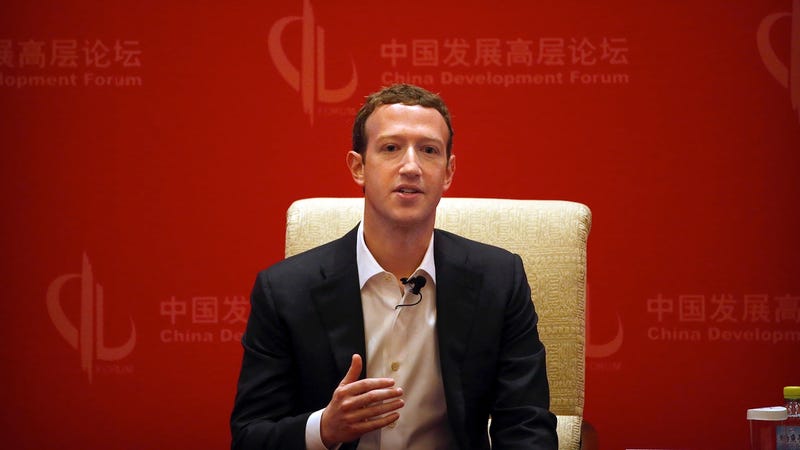
Photo: AP
Have you ever sent an email or text that you wish you could take back and delete forever? That’s not possible on the open web. But we now know that Mark Zuckerberg has the power to reach into every single Facebook inbox and delete messages that he’s sent. Zuck and other executives at Facebook have reportedly used that power multiple times.
The practice only came to light when Facebook users started to examine the information being stored by the social media company using the Download Your Information tool. According to Techcrunch, some people who have exchanged Facebook messages with Mark Zuckerberg have noticed that their old messages from Zuckerberg were gone
Messenger has a feature that allows users to send messages that delete automatically, but that was only introduced in 2016. Users report that messages with Zuckerberg from as far back as 2010 have been deleted remotely, leaving only the recipient’s side of the conversation.
But it wasn’t just Zuckerberg who was deleting his sent messages. A Facebook statement makes it clear that multiple executives at the company have probably done this.
From Facebook (emphasis mine):
After Sony Pictures’ emails were hacked in 2014 we made a number of changes to protect our executives’ communications. These included limiting the retention period for Mark’s messages in Messenger. We did so in full compliance with our legal obligations to preserve messages.
Bringing up the Sony hack might elicit some sympathy for this idea that Facebook executives should be able to delete communications they have with outside parties. But no one outside of Facebook’s top brass have this luxury, as far as we know. And even if it’s not illegal, it seems like an enormous betrayal of reasonable user expectations about how online communities should work.
Again, we’ve all sent an email or message that we regretted. But once it’s in the hands of the recipient, that person has control over the message like you would a hand-written letter on paper. The sender doesn’t get to take it back with just a click. Or, at least, they shouldn’t be able to do that according to established norms.
All of this news comes as Facebook faces intense scrutiny from both the public and governments around the world over its mishandling of user data. It was revealed in March that the private data of 50 million Facebook users was given to Cambridge Analytica, a company that used that information for targeted advertising during the 2016 presidential election. Facebook has since admitted that it was probably more like 87 million people and that every single user has likely had their public profiles scraped.
Zuckerberg is scheduled to testify in front of two Congressional committees next week. The Facebook CEO will be in front of the Senate Judiciary and Commerce Committees on Tuesday, April 10th and then visiting the House Energy and Commerce Committee on Wednesday the 11th. Zuckerberg has declined to speak in front of the UK House of Commons despite repeated requests for him to travel to London.
Facebook’s Sheryl Sandberg gave multiple high-profile interviews yesterday to media outlets like Bloomberg and NBC News. In an interview with NPR, Sandberg blamed the company’s failures to protect the privacy of its users on idealism.
“We really believed in social experiences. We really believed in protecting privacy. But we were way too idealistic. We did not think enough about the abuse cases,” Sandberg told NPR.
We still have a lot of questions about Facebook’s practice of remotely deleting the communications of its executives. How many people at Facebook have the ability to delete their sent messages? Is this being done automatically or on a case-by-case basis? We’ve reached out to Facebook for answers and will provide an update if we get any.
05/04/2018
Facebook announces how it will restrict third-party access from user data
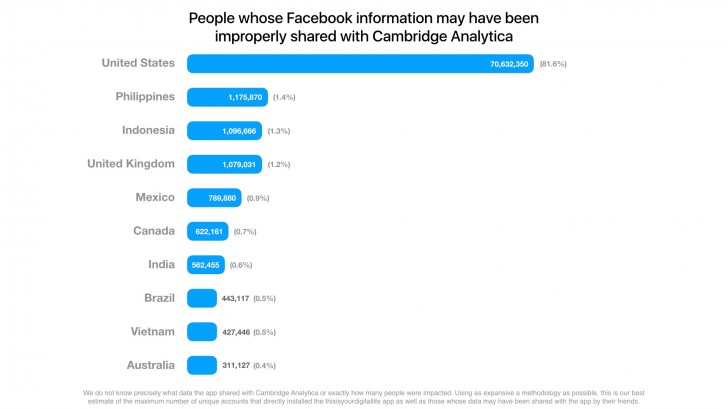
A couple of weeks ago, Mark Zuckerberg made a statement following the realization that Facebook's platform was used to influence the outcome of the 2016 United States election. Today, Facebook offers a more specific look at how exactly it is restricting users' data from falling into the wrong hand while admitting that at least 87 million accounts' information were improperly shared with Cambridge Analytica (70 million accounts were of the US).

A lot of user data was available through APIs, or Application Program Interface, which would allow third parties to pull information from various modules of Facebook like Events, Friend lists, Groups, and Pages. Facebook is restricting the data available to third-parties from these modules as well as making it harder for anyone to hack in using weak account recover options.
Facebook login will now explicitly require approval from the user before allowing information like check-ins, photos, videos, post, events, and groups from being shared with a third-party. Also, starting today, third-party apps are no longer allowed to request access to personal information like religious./political views, relationship status, fitness activity, custom friend lists, education/work history, music listening activity - basically anything that would expose your personal likes or dislikes.
In the next week, developers will no longer have access to any user's information if their app has not been used in three months.

Here are a few other things that Facebook is doing to protect user data:
You can no longer search for a Facebook profile by phone number or email address.
Call and text history doesn't collect message data, but rather who you message/call most frequently. You can opt-out of this and all logs older than one year will be deleted.
The Instagram API has been changed
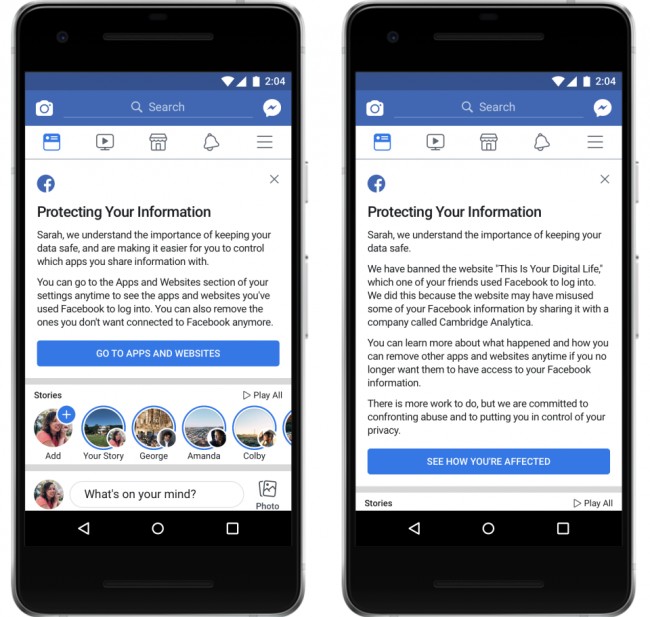
Starting Monday, April 9, Facebook users will see a link at the top of the Newsfeed to see what apps they use and what information those apps can access.
Facebook will tell people if their data may have been improperly shared with Cambridge Analytica.
Check out the Source 1 link for the Facebook Newsroom post or check out Source 2 for a technical breakdown of everything that Facebook is doing moving forward.
21/03/2018
Mark Zuckerberg releases statement in light of ongoing data scandal
We have a responsibility to protect your data, and if we can't then we don't deserve to serve you. I've been working to understand exactly what happened and how to make sure this doesn't happen again. The good news is that the most important actions to prevent this from happening again today we have already taken years ago. But we also made mistakes, there's more to do, and we need to step up and do it.
- Facebook will investigate all apps that had access to large amounts of information from before the 2014 update and will audit any apps with suspicious activity and will ban any developer that does not cooperate with a thorough audit and Facebook will notify all users of the app including those people who used Kogan's personality app.
- Facebook will further restrict developer's access to personal data by removing developer's access to data if a user hasn't used the app in three months. The only thing that developers will be able to see from then on will be name, profile photo, and email address. In addition to user approval, devs will also need to sign a contract before asking anyone for further info.
- In the next month, Facebook will show all users a tool at the top of the News Feed that can be used to revoke apps that you've allowed access to your info in the past. (This tool already exists in the Privacy settings, but Facebook will highlight it in the News Feed so it's more visible).
I started Facebook, and at the end of the day I'm responsible for what happens on our platform. I'm serious about doing what it takes to protect our community. While this specific issue involving Cambridge Analytica should no longer happen with new apps today, that doesn't change what happened in the past. We will learn from this experience to secure our platform further and make our community safer for everyone going forward.
15/03/2018
Facebook Lite reaches the US, UK, and other developed countries
01/03/2018
Snapchat challenging Facebook among US youth

Washington: Facebook remains the most popular social network among Americans but faces a growing challenge from Snapchat for young audiences, a survey showed Thursday.
The Pew Research Center survey showed Facebook holding the dominant platform with 68 percent of Americans using the world’s biggest social network.
While Facebook leads the other social networks in all age groups, the gap has narrowed in the key 18-24 segment, where 78 percent use Snapchat compared with 80 percent for Facebook, Pew researchers found.
Facebook-owned Instagram, which emphasizes pictures and video, is also popular with some 71 percent of that age segment, Pew found.
The study is the latest highlighting Facebook’s challenge of keeping its core youth audience, while adding older users, amid growth in newer social networks like Snapchat, known for its disappearing messages and media snippets.
“As was true in previous years, Facebook remains the entry point to the world of social media for a majority of Americans,” said Pew research associate director Aaron Smith.
“At the same time, Americans today utilize a diverse range of online social platforms in addition to Facebook. And this is especially true of the youngest adults, many of whom have fully incorporated platforms such as Snapchat and Instagram into their social media diets.”
Pew found the median American uses three social platforms with considerable overlap among Facebook, Instagram and Snapchat.
Twitter, meanwhile, continues to lag other platforms with 24 percent of Americans using the short messaging service.
Twitter recently reported its first-ever quarterly profit even though its global user base remained unchanged at 330 million compared with more than two billion for Facebook.
Pew said YouTube, which it does not consider a social network even though it has “social elements,” is used by 73 percent of US adults.
The report is based on a survey via mobile or landline telephone of 2,002 US adults from January 3-10 with a margin of error estimated a 2.4 percentage points for the full sample.
Two weeks ago, a report by eMarketer said Facebook is losing youths at a faster-than-expected pace and that many are turning to Snapchat.
Facebook has launched a Messenger Kids application for users under 12, with parental controls, saying many children already use messaging applications on their own.
Snapchat has faced problems of its own recently amid complaints about an application redesign which separates friends and media content, with a tweet from reality star Kylie Jenner causing a stock plunge. – AFP
15/02/2018
Facebook launches Messenger Kids for Android

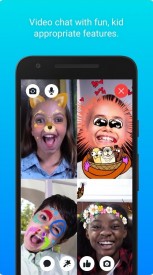
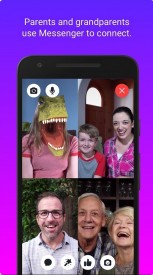
Facebook's modified Messenger Kids app is now available on Android, having been already available on iOS and Amazon Fire tablets. The application is aimed at 6- to 12-year old children and lacks in-app purchases or Hide options so that parents can have more control over any unsolicited messages.
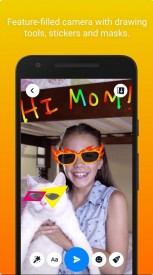
The app gives kids the ability to have more fun, the listing on the Play Store claims. Facebook added kid-appropriate stickers, GIFs, frames and emojis to help kids “creatively express themselves.” There are also one-to-one video calls with interactive AR masks.
Unlike the regular Messenger app, the Kids version does not ask for a phone number or need a Facebook account. Parents and approved grown-ups can use their profiles to verify the Kids account and can also check up what is going on through the regular Messenger.
Kids can block contacts and report inappropriate content in the app. When they do that, the parent or guardian will be notified.
30/01/2018
Facebook says it will begin putting more local news into the News Feed
It’s time to “turn down the temperature” on divisive issues, says Mark Zuckerberg
/cdn.vox-cdn.com/uploads/chorus_image/image/58496499/facebook-new-news-feed1_2040.0.jpg)